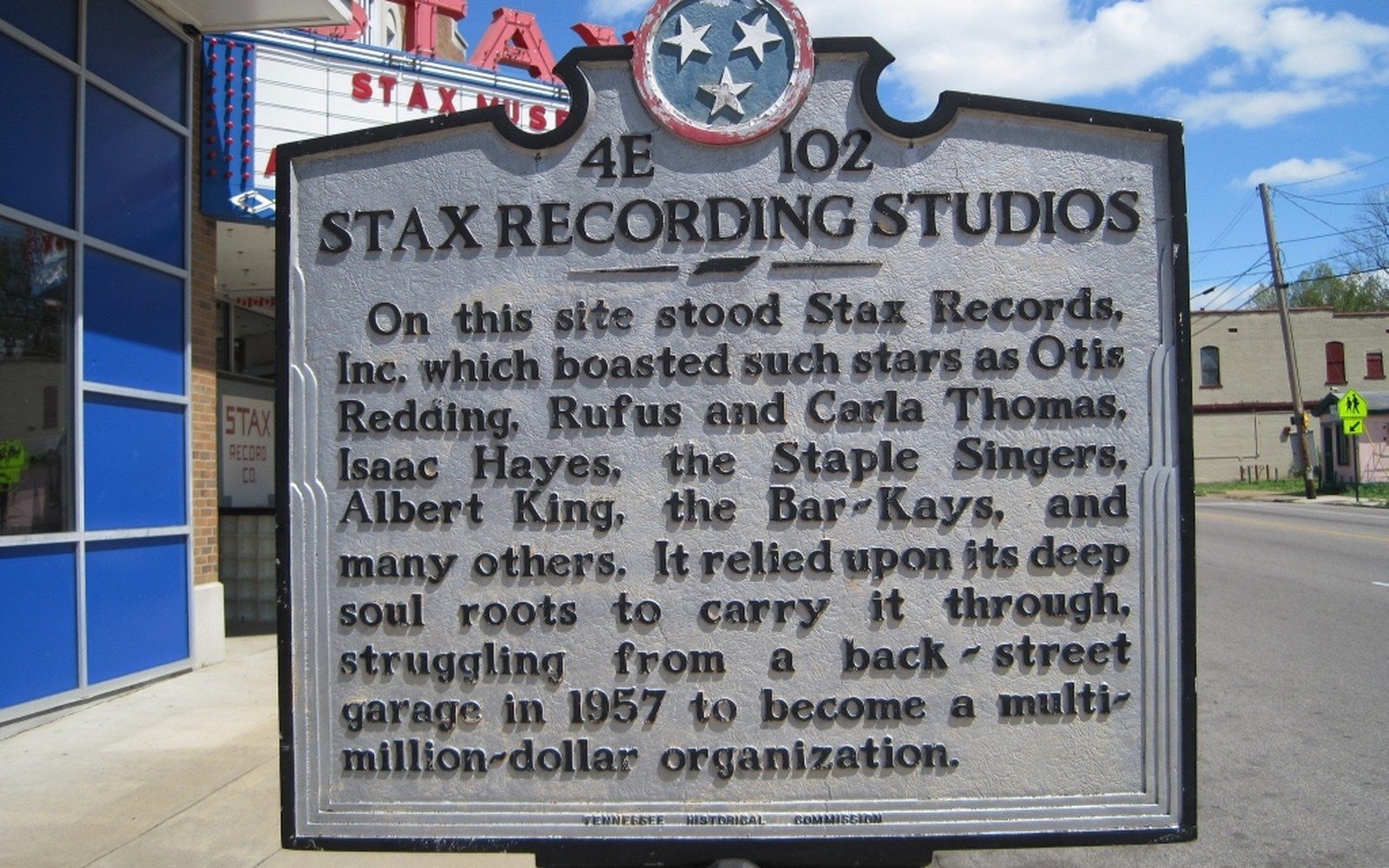
The historical marker on McLemore Avenue. Stax outlived its studio; the masters went elsewhere.
Photo: Stax Museum Memphis TN 02 Marker · Wikimedia Commons
Record labels: the rooms, the people, the catalogues.
How a handshake deal with Atlantic left Memphis's greatest soul label without its own recordings
The historical marker on McLemore Avenue. Stax outlived its studio; the masters went elsewhere.
Photo: Stax Museum Memphis TN 02 Marker · Wikimedia Commons
Jim Stewart was a country fiddle player and part-time banker when he converted a disused Capitol Theatre on McLemore Avenue in Memphis into a recording studio in 1960. His sister Estelle Axton mortgaged her house to finance the label's first Ampex tape machine — a fact that explains, more viscerally than any business history can, what was lost when the contract finally came to light. The name Stax compressed their surnames: Stewart, Axton. The building compressed something else: the neighbourhood's Black musical culture into a space where Booker T. Jones, Duck Dunn, Steve Cropper and Al Jackson created a rhythm section that became one of the most recorded in American music.
The label's working method was inseparable from its physical address. The old cinema's sloped concrete floor, its plaster walls and its stage created an acoustic character that engineers exploited rather than corrected — a close, dry, hot sound that bore no resemblance to what Chess Records was cutting in Chicago or what Motown was assembling on West Grand Boulevard, Detroit. Stax recorded live in the room, musicians and vocalist together, and the imperfections stayed in. The result was a sound that felt urgent in a way that overdubbing could not simulate.
| Distribution deal | contract by which a major label handles manufacture and retail delivery for an independent |
| Master recording | the original source from which all copies and licences derive; its ownership determines catalogue value |
| Lease deal | arrangement under which a distributor licenses masters, sometimes granting the distributor ownership rights |
Otis Redding arrived in 1962, initially as a driver for Johnny Jenkins, and cut "These Arms of Mine" almost incidentally at the end of a Jenkins session. It became Stax's first genuine national seller. By 1965 Redding was the label's signature artist, recording at a pace that generated Otis Blue (1965) and Complete & Unbelievable (1966) in successive years. Atlantic Records, which had signed a distribution agreement with Stax in 1961, handled manufacture and retail delivery while Stax retained — or believed it retained — creative control and catalogue ownership. The deal worked, commercially, for most of the decade.

Van Gelder worked with few microphones, placed precisely, and did most of his deciding before the tape ran.
Photo: Anna Pou / Pexels

An LP sleeve under a lamp. The cover was the only part of a record a buyer could examine before paying for it.
Then Redding died in a plane crash in December 1967, and Atlantic was sold to Warner-Seven Arts in 1967. The legal review that followed the acquisition produced a finding that reorganised independent label history: the 1961 distribution agreement had been structured, in practice, as a lease deal, and Atlantic held ownership of the masters recorded under it — every Stax and Volt release from 1961 through to the sale. Stewart and Axton had understood themselves to be licensing distribution rights. The contract, as written and subsequently interpreted, said otherwise.
The commercial scale of what this meant was immediate. Stax's entire catalogue up to that point — Redding, Booker T. & the M.G.'s, Sam & Dave, Eddie Floyd — belonged to Atlantic. Stewart negotiated a new distribution arrangement with Gulf + Western's Paramount Pictures and eventually with Columbia, but without its back catalogue the label was rebuilding on empty ground. A second creative period followed in the late 1960s and early 1970s, with Isaac Hayes's Hot Buttered Soul (1969) demonstrating that Stax could still produce records of genuine commercial weight. But the financial architecture was permanently weakened, and by 1975 the label had filed for bankruptcy.
The lesson embedded in that 1968 discovery was structural. A distribution deal — the contract by which a major handles manufacture and retail delivery for an independent — could be drafted so that the master recording, the original source from which all copies and licences derive, passed to the distributor rather than remaining with the creator. Independent labels reading their own contracts more carefully after Stax, insisting on explicit master ownership clauses, were responding to a real and documented precedent. The Stax case is cited in music industry legal literature as a primary reason why subsequent independent deals were negotiated with ownership language spelled out rather than assumed. Estelle Axton mortgaged her house for the tape machine. Atlantic walked away with what the tape machine recorded.