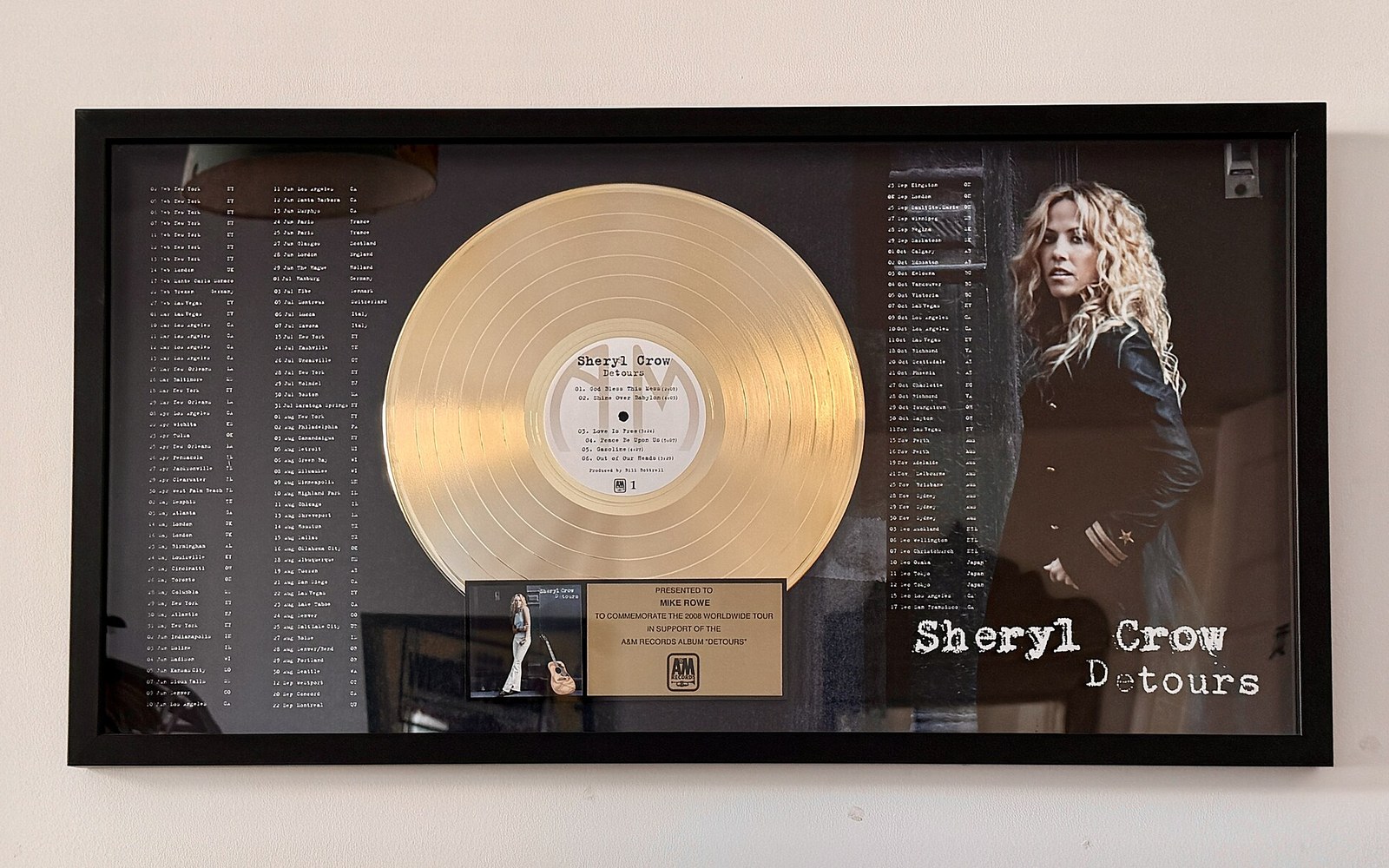
A framed gold award. The certification is a threshold, and the threshold has moved.
Photo: Sheryl Crow - Detours - RIAA Gold Award - Presented to Mike Rowe · Wikimedia Commons
Record labels: the rooms, the people, the catalogues.
RIAA gold and platinum thresholds have changed since 1958, so a gold record on a 1974 album and one on a 2016 release are not the same claim.
A framed gold award. The certification is a threshold, and the threshold has moved.
Photo: Sheryl Crow - Detours - RIAA Gold Award - Presented to Mike Rowe · Wikimedia Commons
The RIAA launched its gold record programme in 1958, certifying albums that had reached $1 million in sales value and singles that had shipped one million copies. Those were shipment figures, not sales: a label applied, submitted invoices and distributor data, and the RIAA verified the threshold had been crossed. Returns could complicate the picture, which is why "shipped" and "sold" became a meaningful distinction for anyone reading the business press carefully.
The first threshold revision came in 1975, when the album bar dropped to 500,000 units — half the original figure. The market had expanded enough that a million-unit album had become a blockbuster rather than a baseline, and the RIAA adjusted accordingly to keep the certification relevant to a broader catalogue tier.
Platinum arrived in 1976, set at one million albums or two million singles. The distinction mattered: a platinum album certification from 1976 onward indicated a higher commercial tier than gold, whereas before that year no such second level existed. Multi-platinum followed in 1984, adding incremental tiers at each additional million units.
The digital download era required another recalibration. From 2004 the RIAA incorporated paid download sales into certification counts, with 10 downloads equating to one album unit — a ratio reflecting the then-prevailing expectation that not every download buyer would have purchased a full album. Singles certifications were adjusted separately on a track-by-track basis.
Streaming equivalencies arrived with a formal rule change announced by the RIAA in February 2016. Under that framework, a fixed number of on-demand streams count as the equivalent of one paid download, so streaming activity converts into certification units. That ratio has since been used to certify catalogue records that had never previously reached a threshold — older albums crossing a million-unit equivalent for the first time decades after release, their streaming tallies finally pushing them over the line.

Van Gelder worked with few microphones, placed precisely, and did most of his deciding before the tape ran.
Photo: Anna Pou / Pexels

An LP sleeve under a lamp. The cover was the only part of a record a buyer could examine before paying for it.
The practical consequence for anyone reading a certification citation is straightforward but often ignored. A gold album certified in 1965 represents 1,000,000 shipped copies — a physically manufactured and distributed figure. A gold album certified after 2016 may reach its 500,000-unit equivalent partly or entirely through streams accumulated over years. The underlying commercial achievement is real in both cases; the mechanism, the market context, and the order of magnitude of physical production are entirely different. Treating both certifications as equivalent without noting the era is a common shorthand that quietly distorts the historical record.