
A shelf of pale uniform spines. The house grammar is as recognisable as the reverb tail.
Record labels: the rooms, the people, the catalogues.
How a Munich label turned silence, space and a photographic aesthetic into one of recorded music's most recognisable identities's most recognisable identities
A shelf of pale uniform spines. The house grammar is as recognisable as the reverb tail.
ECM Records was founded in Munich in 1969 by Manfred Eicher, a bassist and former student at the Berlin Hochschule für Musik. The initials stand for Editions of Contemporary Music, and the name was always a statement of intent: this was a catalogue, not merely a roster. The label's first release, Mal Waldron's Free at Last, appeared that year, and within a decade ECM had recorded Keith Jarrett, Jan Garbarek, Chick Corea, Dave Holland and Paul Bley — artists who were remaking the boundaries between jazz, folk and composed music. What united them on record was less genre than atmosphere.
The atmosphere was deliberate. Eicher produced most of the label's sessions himself, and his controlling interest was the acoustic environment of the recording — particularly the relationship between a sound and the space it decayed into. He favoured large, reverberant rooms: Norwegian churches and concert halls recur in the session notes, as do studios where a piano chord could sustain for several seconds before the room released it. That preference gave ECM recordings their characteristic quality — a sense of air around every instrument, silence treated as a compositional element rather than the absence of content. Critics reached for the word "ECM sound" so consistently that it became a genuine descriptor in music journalism, shorthand for a specific blend of Nordic spaciousness and post-bop introspection.

The unit of the whole business is three hours in a room with a clock running.
Photo: Anna Pou / Pexels
No single facility defined ECM's recorded identity, but the label's relationship with Arne Bendiksen Studio in Oslo, and later the concert halls and churches of Scandinavia and Germany, was central to the catalogue's first two decades. Jarrett's Facing You, recorded in Oslo in 1971, established the template: a solo piano session in which the room is almost a second instrument. His subsequent Köln Concert of 1975 — recorded live at the Cologne Opera House and certified multi-platinum in Germany — became the best-selling solo piano album in history, its success inseparable from the recorded acoustic. The room breathed, and listeners heard it.
Eicher did not impose a fixed technical specification on his engineers. What he demanded was attention to placement — of microphones, of musicians relative to one another and to the room's reflective surfaces. The result was a style of recording that sounded, paradoxically, less produced than competing jazz labels while actually being more precisely controlled. The ECM sound was not captured; it was constructed.
The visual language arrived alongside the sonic one. ECM sleeves, from the early 1970s onward, shared a set of recurring properties: photography rather than illustration, a preference for landscape and architectural images over portraits, restrained typography in a consistent sans-serif face, and white or pale ground colours that gave the spines a distinctive library appearance on a dealer's shelf. Dieter Rehm and Barbara Wojirsch shaped the label's graphic programme through its foundational years, establishing conventions that subsequent designers maintained.
The connection between cover and recording was not metaphorical. Eicher has spoken of wanting the cover photograph to occupy the same emotional territory as the music inside — not to illustrate it, but to resonate at the same frequency. A Garbarek session might be clothed in a snow-field or an empty fjord; a Paul Motian record in grain and distance. The photographs were often sourced from established fine-art photographers rather than commissioned for the purpose. The cover was, in this sense, a curatorial act as much as a design one.
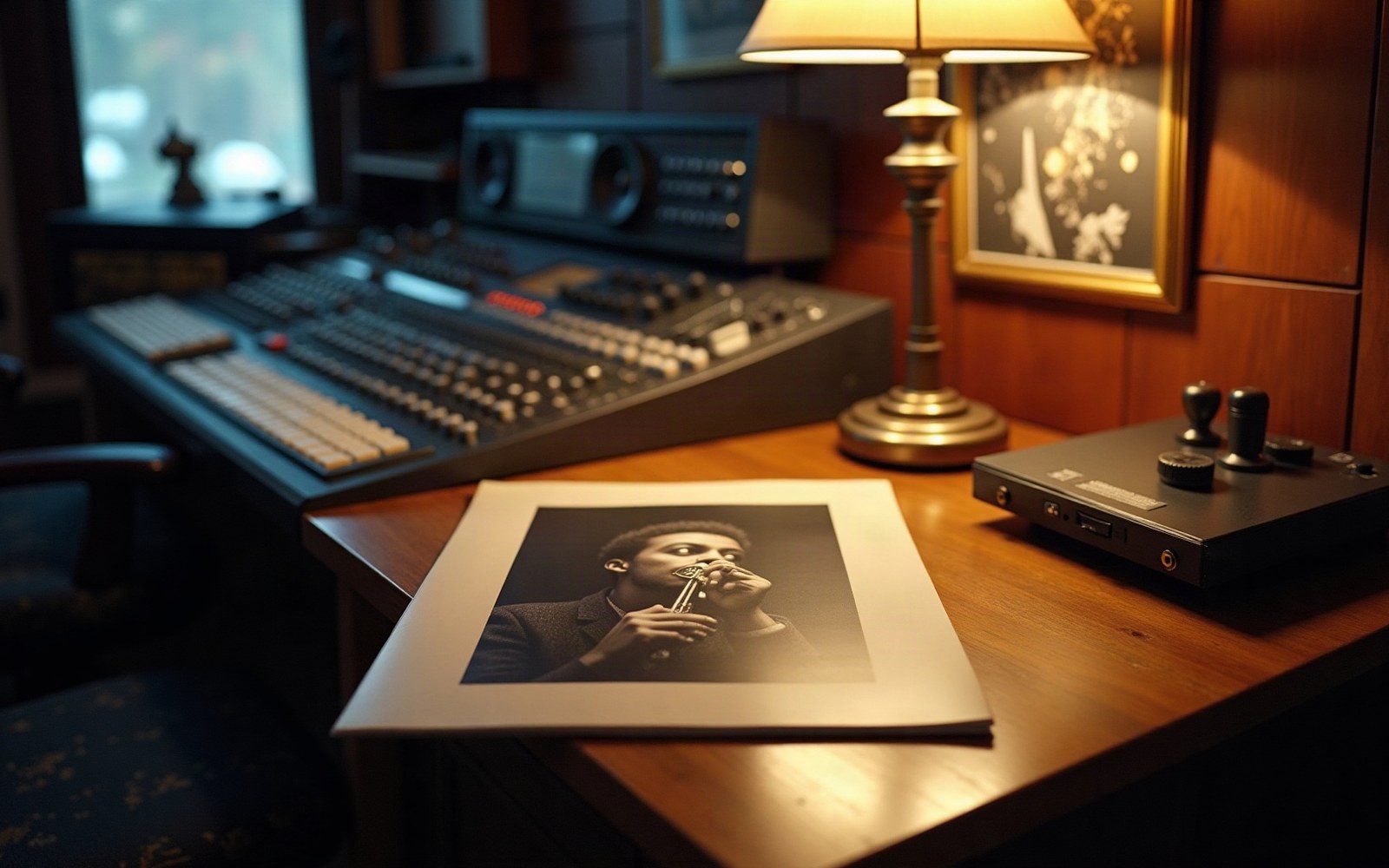
An LP sleeve under a lamp. The cover was the only part of a record a buyer could examine before paying for it.
By the 1980s ECM had expanded its New Series imprint to accommodate contemporary composed music — Arvo Pärt, Steve Reich, and works from the early music tradition — and the visual grammar adapted without breaking. The label's catalogue, which now runs to well over 1,500 releases, reads as a single coherent object: a body of work in which the reverb tail, the typographic choice and the photographic frame are aspects of the same decision.