
New York University. Def Jam’s first records were run out of a dormitory room here.
Photo: Keira Burton / Pexels
Record labels: the rooms, the people, the catalogues.
Def Jam's first three years demonstrate how a production aesthetic, not a building, can be a label's primary asset.
New York University. Def Jam’s first records were run out of a dormitory room here.
Photo: Keira Burton / Pexels
Rick Rubin was a New York University undergraduate when he co-founded Def Jam Recordings in 1984, using his dormitory room in Weinstein Hall as an office, rehearsal space, and nerve centre. His partner, Russell Simmons, already ran Rush Communications and managed hip-hop acts including Run-DMC; Rubin brought recording equipment and an instinct for sonic reduction. The arrangement was undercapitalised by any conventional measure, yet it produced a sound immediately identifiable as Def Jam: drums stripped to their hardest transient, bass frequencies placed like furniture, vocals dry and close.
The label's early sessions were cut at Chung King House of Metal, a studio on Mott Street in lower Manhattan, where Rubin imposed the same aesthetic regardless of genre. The first significant release, LL Cool J's "I Need a Beat" (1984), sold roughly 100,000 copies independently — enough to attract Columbia Records. The distribution deal signed with Columbia in 1985 gave Def Jam pressing, distribution and a cash advance while leaving creative control, and crucially the master recordings, in Simmons and Rubin's hands. This was the structure Atlantic had exploited from the other side of the table a generation earlier: a major absorbs the distribution risk, an independent retains the catalogue.
What Columbia bought access to was not a roster but a production identity. Rubin's mixes for Run-DMC's "Rock Box" and, later, the collaboration with Aerosmith on "Walk This Way" (1986) treated rock guitar and hip-hop drums as the same instrument class. The resulting records crossed radio formats in a way that neither genre had managed alone. Run-DMC's Raising Hell (1986), released on Profile Records rather than through the Columbia deal, was certified triple platinum by the RIAA — the first hip-hop album to reach that threshold.

The unit of the whole business is three hours in a room with a clock running.
Photo: Anna Pou / Pexels
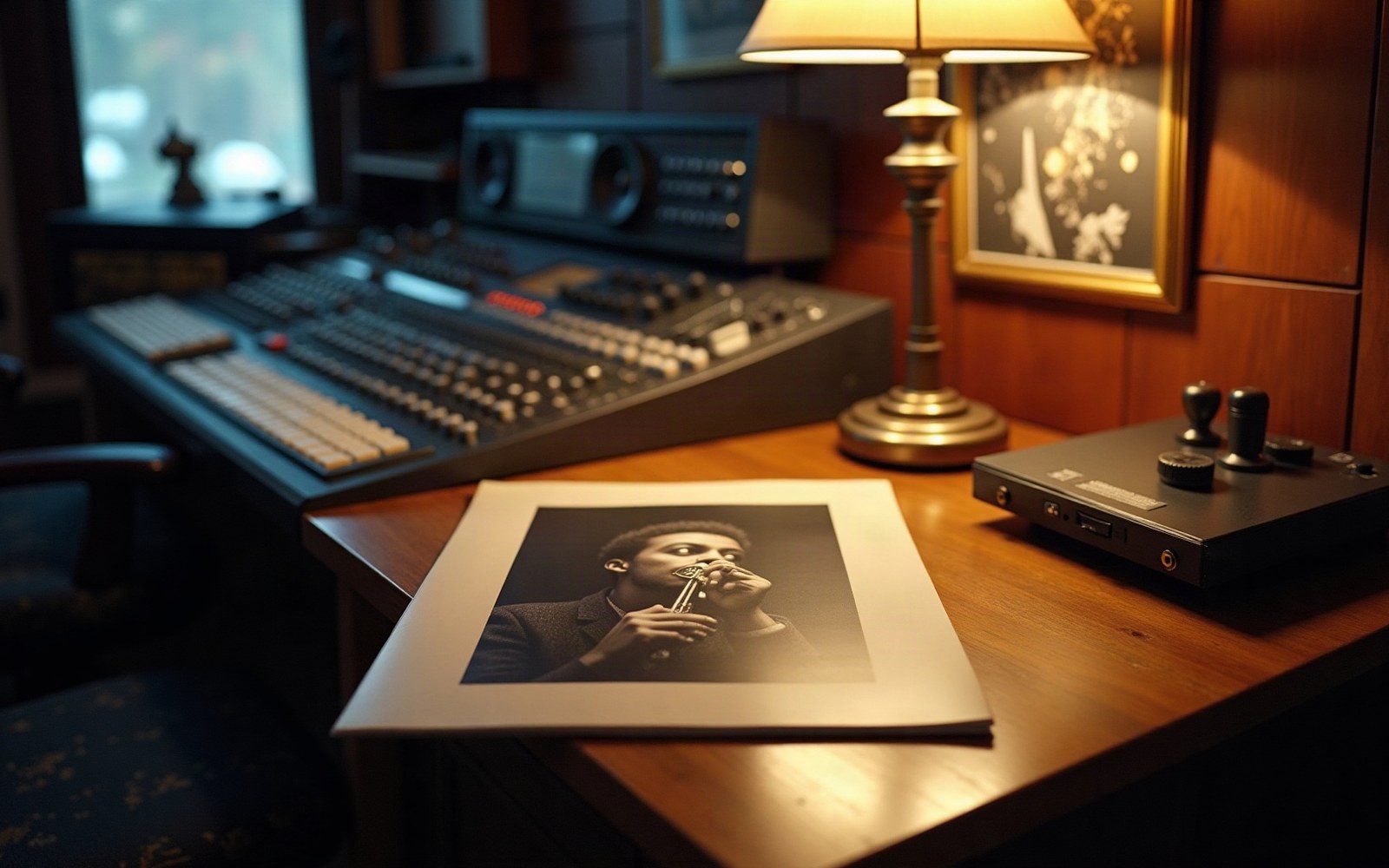
An LP sleeve under a lamp. The cover was the only part of a record a buyer could examine before paying for it.
LL Cool J's debut Radio (1985), produced by Rubin and bearing the catalogue number FC 40239, appeared on the Columbia-distributed Def Jam imprint with artwork as stark as the recordings: white typography on black, nothing decorative. The sleeve design was a statement of the same aesthetic philosophy the production embodied — subtract until what remains cannot be ignored.
By 1988, when Rubin departed to found Def American, the label had established something durable: a proof that a distribution deal with a major, structured correctly, could amplify an independent's reach without dissolving its identity. The dormitory room was long gone, but the sound it produced had defined what a hip-hop record was supposed to feel like.